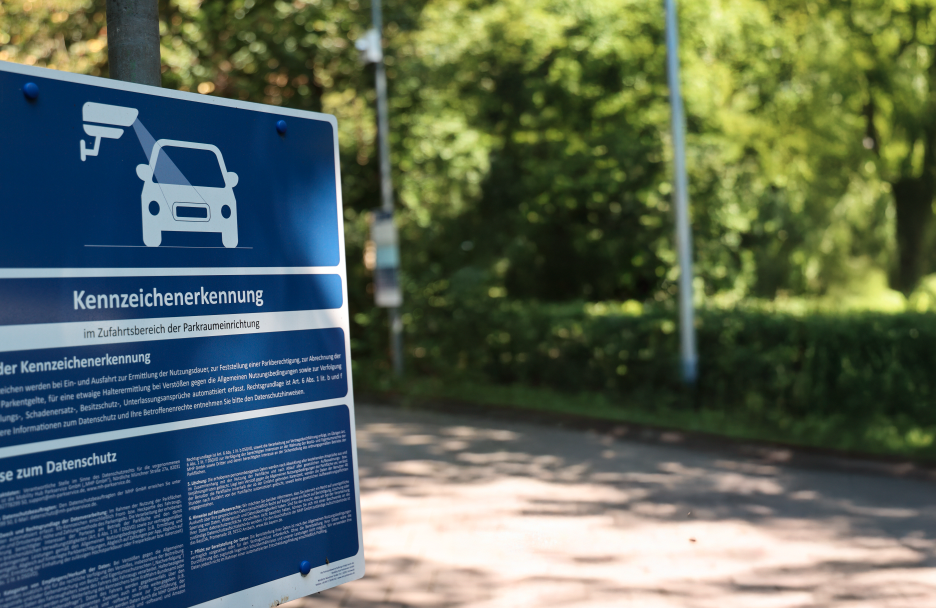
In this blog post, we answer the 10 most important questions to show how safe and easy it is to park without barriers from a legal standpoint:
- How does barrier-free parking work from a legal standpoint?
- What is included in this contract, and what should you look out for?
- No barrier means free parking?
- What is the grace period, and what role does it play?
- Why is the penalty higher than the regular fee?
- How is the amount of a contractual penalty calculated?
- Who is liable if I lend my vehicle to someone?
- What personal data is stored? Is this in compliance with the law?
- Why is Mobility Hub, as a private institution, able to impose a contractual penalty?
- How does the collaboration with the Federal Motor Transport Authority (KBA) work?
How does barrier-free parking work from a legal standpoint?
Like any contract, the digital parking service agreement is formed through an offer and acceptance:
- The operator’s offer is indicated by clear signage at the entrance and the provision of the parking space: I have a parking space and I am offering parking there subject to certain General Terms and Conditions of Use (GTC, including license plate recognition and payment of the parking fee) (so-called actual offer).
- Driving onto the lot and parking the vehicle are considered implied acceptance of this offer by the person parking: Yes, I would like to park here and accept the terms of use.
This constitutes a legally binding agreement for the use of the parking space, in the form of a lease agreement, under the terms and conditions posted on-site, without the need for any further declarations of intent. Scanners are used to record the times of entry and exit in order to determine the exact parking duration, which serves as the basis for the payment process.
What is included in this contract, and what should you look out for?
Upon entering the parking lot, the posted General Terms of Use (GTU) become an integral part of the contract as general terms and conditions. These rules cover aspects such as payment processing, rules of conduct on the premises, and services provided by the operator. The person parking must have a reasonable opportunity to take note of the content through a clearly visible notice. It is not legally required that these terms be fully understood while driving past. What matters is that their existence is clearly visible at the entrance. After parking the vehicle, there is an opportunity to review the details at one’s leisure on site.
No barrier means free parking?
The absence of a physical barrier does not exempt parkers from the obligation to pay. Failure to pay the parking fees constitutes a violation of the terms of use for the parking area. The General Terms and Conditions of Use (ANB) stipulate a contractual penalty for this situation.
What is the grace period, and what role does it play?
After entering the parking lot, as an exception to the general rule that parking is subject to a fee, a defined period is granted during which no parking fee is charged. This period allows you to orient yourself within the lot or search for an available space. If you leave the lot within this grace period, as specified in the General Terms and Conditions, no charges will apply. However, if this period is exceeded, the entire duration is considered a parking session. A parking session is defined as the period between entering and exiting the parking area. The definition of parking in § 12 StVO does not apply.
Why is the penalty higher than the regular fee?
The amount of the contractual penalty (increased usage fee) is intended to exert the most effective pressure possible to ensure that the parking user complies with their obligations and to deter violations. Furthermore, the contractual penalty can be used to offset the significant additional costs incurred as a result of non-payment. However, a claim for a contractual penalty exists even if no specific damage has occurred. It is therefore an instrument independent of damages that serves a dual legal function. Unlike administrative fines, there is no rigid government schedule of costs here. However, the case law of the Federal Court of Justice confirms that these amounts may be significantly higher than the original parking costs in order to have a preventive effect.
The principle of proportionality always applies here: a contractual penalty must be proportionate to the breach and the resulting costs. We use the amount of comparable administrative fines under public law as a point of reference.
How is the amount of a contractual penalty calculated?
The amount of a contractual penalty is not an arbitrary figure, but the result of an objective calculation. A major cost driver that does not arise in the public sector is the vehicle owner inquiry submitted to the Federal Motor Transport Authority (KBA). In order to determine the identity of the vehicle owner, fee-based inquiries must be made.
In addition to the costs associated with identifying the vehicle owner through the KBA, there are also postage and delivery fees for printing, enveloping, and mailing the penalty notice, as well as administrative costs for handling inquiries and providing customer service.
These cumulative costs alone explain why a private contractual penalty is often higher than a simple administrative fine imposed by a municipality. The principle of proportionality ensures that these surcharges remain moderate and primarily cover the additional expenses incurred, rather than serving as a mere source of revenue.
The amount of the contractual penalty is also justified by its necessary deterrent function. It must be set at a level that provides an effective incentive to comply with the terms of use and makes deliberate non-compliance economically unattractive, in order to ensure the proper use of the space on a long-term basis.
Who is liable if I lend my vehicle to someone?
If the vehicle was not parked in the parking lot by the owner himself, the driver of the vehicle is generally liable. Since unrestricted parking management is an anonymous, large-scale operation that, by its very nature, operates “without personal contact,” it is impossible to identify a driver other than the owner without the owner’s assistance. Therefore, the assertion of a claim against the vehicle owner is sufficient to enforce it. In the event of judicial enforcement of the claim, the vehicle owner could not limit themselves to asserting that the vehicle was lent out or disputing their status as the driver, as there is a so-called secondary burden of proof in court. It is incumbent upon the vehicle owner to investigate and clearly identify who could have used the vehicle in their place. In addition to contractual claims, the vehicle owner is also liable as a “disturber of the peace,” since they have control over the source of the disturbance—the vehicle. If they fail to identify the driver upon request, they are liable to prevent further disturbances caused by their vehicle.
What personal data is stored? Is this in compliance with the law?
Data protection is our top priority. Upon entry and exit, only images of the vehicle’s license plate area, including a timestamp, are captured. No images of individuals or video recordings are taken. The collection and storage of data are based on Article 6(1)(b) and (f) of the GDPR (performance of a contract and legitimate interest). Provided there is no violation of the rules and no paid use of the parking area, this data is routinely deleted after 48 hours, and the vehicle owner remains anonymous.
Why is Mobility Hub, as a private institution, able to impose a contractual penalty?
The authority to impose a contractual penalty as a contractual claim derives directly from the management of the parking area and the applicable terms of use for the parking area.
From a legal standpoint, the payment demand is not an administrative fine (as in the context of public road traffic law), but rather a contractual penalty under civil law. This penalty is incurred if the terms of the user agreement are violated. In order for Mobility Hub to enforce these claims, certain clear conditions must be met:
- Clear signage: The rules must be clearly displayed at the entrance.
- Legitimate interest: In the event of a payment violation, the operator has a legally recognized “legitimate interest” pursuant to Article 6(1)(f) of the GDPR and Section 39(1) of the Road Traffic Act (StVG). This allows Mobility Hub to submit a vehicle owner inquiry to the Federal Motor Transport Authority (KBA) in order to send the claim to the vehicle owner by mail.
While the police and the public order office are responsible exclusively for public roadways, Mobility Hub ensures fair conditions for all users on private property and protects parking spaces from misuse.
How does the collaboration with the Federal Motor Transport Authority (KBA) work?
The identification of vehicle owners is strictly regulated in the private sector. Mobility Hub operates within a clear legal framework to ensure fairness and legal certainty.
The identification of vehicle owners is strictly regulated in the private sector. Mobility Hub operates within a clear legal framework to ensure fairness and legal certainty.
Why is Mobility Hub allowed to request data from the KBA?
Under Section 39(1) of the Road Traffic Act (StVG), the Federal Motor Transport Authority (KBA) may disclose vehicle owner data from the Central Vehicle Register if this is necessary to assert, secure, or enforce legal claims related to participation in road traffic. Since a violation of parking regulations gives rise to a civil claim in connection with road traffic, the owner inquiry is legally permissible and provided for.
How does the query process work?
If payment is not made within the specified time frame after parking, an automated request is sent to the KBA. Only the license plate number and the time of the violation are transmitted. The KBA then returns the information necessary to send the payment notice (name and address of the registered owner).
What requirements must be met?
A query is never made arbitrarily. It is always based on a specific violation of the rules that results in unauthorized use of the parking space, such as:
- Leaving the parking lot without paying the parking fee.
- Exceeding the maximum parking time.
- Parking in areas not designated for that purpose (e.g., emergency access routes).
Is data protection guaranteed in this case?
Absolutely. The transfer of data is subject to strict time limits for specific purposes. The information provided by the KBA is used exclusively for the processing of the respective parking violation. Once payment has been received and the case has been legally closed, the data is deleted after the statutory retention periods have expired. The collaboration with the KBA thus ensures that the identification of the vehicle owner is carried out in accordance with the highest government standards and in compliance with all data protection guidelines.
Clarity builds trust
Barrier-free parking is much more than just modern technology. It is a balanced combination of digital convenience and clear legal guidelines. The goal is always the same: a seamless experience for everyone who uses a parking space, and a transparent process in the unlikely event that something is overlooked.
By combining intelligent license plate recognition, data protection-compliant processing, and close collaboration with official agencies such as the KBA, parking becomes exactly what it should be: simple, safe, and stress-free.