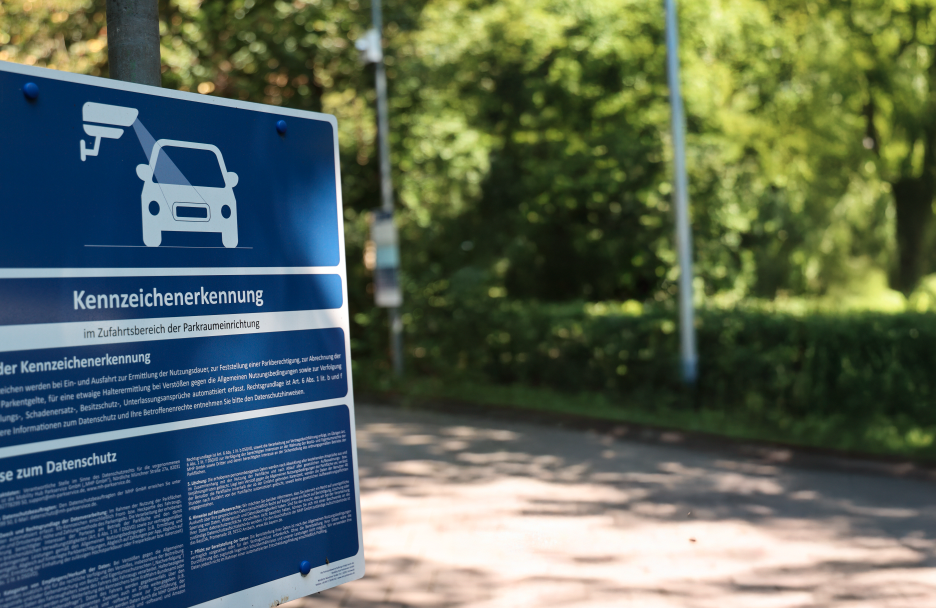
Parking has changed significantly in recent years. The days of tickets and mechanical barriers are a thing of the past. Modern, barrier-free parking systems automatically record the license plates of passing vehicles and enable convenient payment – either on site at the pay station or digitally via a web application. But even in this digitalized world, one element remains indispensable for parkers: transparent signage. It provides orientation, clarity, and legal certainty – from entry to exit.
Clarity right from the start: signs as legal notices
In license plate-based parking, signage serves as both a guide and the legal basis for using the parking space.
For this reason, all essential (legal) information must be visible at the entrance—even before a license plate is scanned:
- A large "P" symbol that generally identifies the area as a parking lot, as well as a notice indicating that it is a paid parking area, if applicable. This clearly shows parkers that they are entering a paid parking lot.
- References to automatic license plate recognition in words and images that make it clear that license plates are being recorded in the parking area.
- The applicable parking conditions, such as any free parking or maximum parking duration, parking rates, and the amount of the increased usage fee in the event of a parking violation.
- Data protection information: Since license plates are personal data, certain data protection information must be included on the signage. This includes information on the purpose, legal basis, responsible party, and storage period.
- The General Terms and Conditions (GTC = Terms of Use). They clearly show the conditions under which parking is permitted and form the basis for the parking space usage agreement.
When road users enter a parking area and pass the corresponding signs with all relevant information, a contract of use is concluded. This means that by entering and using the parking area, the road user agrees to the published terms and conditions without having to sign anything. In legal terms, this is referred to as implied acceptance.
The prerequisite for this is that the signage is installed in front of the scanning area where the license plate is captured. Only then do road users have the opportunity to decide against using (parking) the space before the license plate is captured. In addition, the information mentioned must be clearly and legibly displayed in the prescribed sizes and heights.
Signage at the entrance to a parking area creates safety and ensures that parking can be done correctly and in a relaxed manner.
Orientation on the ground: navigating between digital and analog
Even after entering the parking lot, signs assist parkers and provide them with guidance:
- Information signs: These are placed at regular intervals throughout the parking area, for example along walkways or next to pay stations. There are usually two types of information signs:
- Explanatory signs: Digital parking using license plate recognition is still new to many parkers. To provide guidance, these signs explain barrier-free parking in a clear and step-by-step manner.
- Signs indicating applicable parking conditions: Well-organized parking lots also have signs posted throughout the entire area that indicate the free parking or maximum parking time, parking rates, etc.
- Digital connection: In parking areas where digital payment via smartphone is possible, signs with QR codes or links are also displayed, which take parkers directly to the web application for payment.
- Location of parking meters: Even though digital payments are possible, there are often parking meters that allow on-site payment. To help parkers find these meters quickly, special signs point the way.
This additional signage in the parking area provides parkers with even more guidance, transparency, and security. This creates a clear, intuitive process—regardless of whether payment is made digitally or via the on-site payment machine.
A reminder when leaving: Have you paid the parking fee?
Everyone knows that sometimes things have to happen faster than expected. To prevent parkers from forgetting to pay their parking fees, signs remind them to pay again shortly before they exit. That way, nothing can go wrong.
The value of clear signage
Clear and well-placed signage is the central link between the digital technology in the background and understandable, analog communication for parkers. Especially in barrier-free, license plate-based parking, it makes the difference between uncertainty and a smooth parking experience. Clear, highly visible information provides parkers with orientation at all times: they know where they are, what rules apply, and what steps are required. This transparency enables conscious decisions and correct behavior. At the same time, clear signage creates legal certainty for all parties involved. Parkers are informed about parking conditions, terms of use, and the processing of personal data. Operators fulfill their legal information obligations and create a reliable basis for the user agreement. This makes parking more relaxed overall: everything is clearly regulated, explained in an understandable way, and visible at all times.
Conclusion
Unrestricted parking stands for convenience, efficiency, and flexibility. But for parkers to actually experience these benefits, clear and well-designed signage is essential. It ensures that the digital process remains transparent, that orientation is provided at all times, and that all legal requirements are met. Signage is therefore much more than a supplementary element: it is a guide, a source of information, and a legal basis all at once. The interaction with digital technology enables parking that is not only modern, but also safe, understandable, and worry-free.