Parking is an inevitable part of driving. According to statistics, cars are parked for an average of more than 23 hours a day—meaning they spend much more time parked than they do driving. This makes it all the more important to park your car correctly. It's not just a matter of not obstructing other road users and emergency vehicles; people looking for a parking space should also check whether there is a maximum parking time or whether parking is subject to a charge.
If parkers violate the applicable regulations, they face fines in public spaces and contractual penalties in privately managed parking areas. How much are they and how do they differ?
What is a warning or fine, and what can I get it for?
The catalog of fines specifies which violations in public spaces are punishable.
For example, a typical warning fine is €25 for parking without a valid parking ticket on the side of the road for longer than 30 minutes. The payment request is left directly on the vehicle. If payment is not made, a written fine notice will follow, which will incur additional fees. In practice, the lowest level in public areas is €48.50 for exceeding the time limit by up to 30 minutes; after three hours, the amount increases to €68.50.
However, other traffic violations can be significantly more expensive: According to the Federal Ministry of Transport, prohibitive fines apply for illegal parking on sidewalks and bike paths, as well as unauthorized stopping on protective lanes and double parking. Fines of up to €110 may be imposed. If such behavior endangers or obstructs other road users, causes damage to property, or if the vehicle is parked on the sidewalk or bike path for longer than one hour, the local authority may also enter a point in the driver suitability register.
What is a contractual penalty?
Violations of rules applicable to private parking areas also result in fines. However, these are not warnings or penalties, but contractual penalties. By their implied actions—i.e., using the parking area—parkers enter into a contract with the parking area operator and thereby also accept the applicable rules. The prerequisite is that the rules are appropriately signposted.
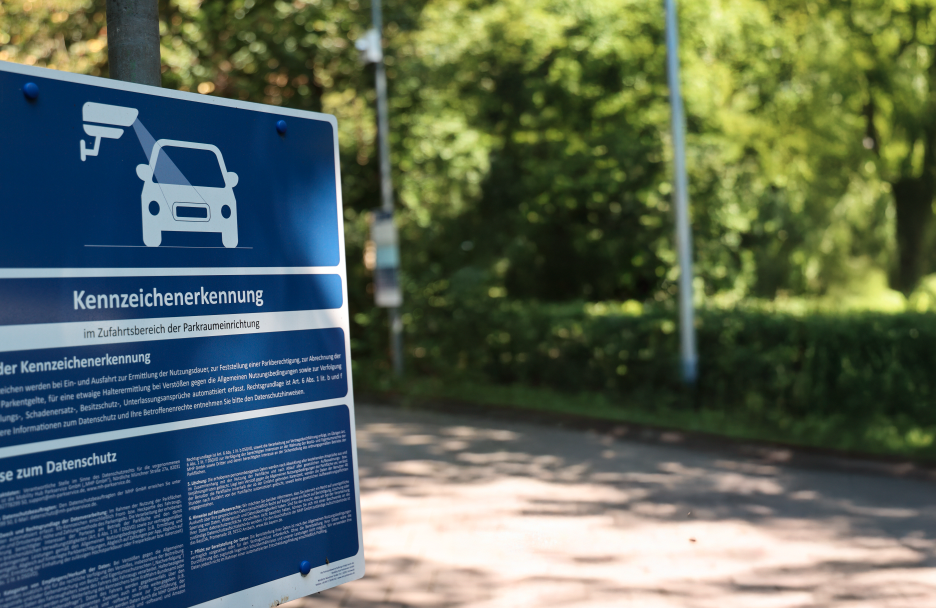
Digital, barrier-free parking management systems automatically record whether parkers comply with the rules or not. In parking areas where free parking is available for a limited time, they check whether a vehicle has been parked within this time period or not. In parking areas where parking is subject to a fee, the system checks whether the parking fee has been paid in sufficient amount for the duration of parking.
If the system detects a violation of the applicable contract and parking conditions, a vehicle owner query is sent to the Federal Motor Transport Authority. This enables the parking lot operator to send the contractual penalty to the vehicle owner by mail.
This request is subject to a fee.
How does the contractual penalty differ from a parking ticket in public spaces?
Warnings and fines are imposed in the public legal sphere when road users in Germany violate laws or regulations such as the Road Traffic Act (StVG) or the Road Traffic Regulations (StVO). Administrative offenses such as illegal parking fall under administrative offense law in the public legal sphere.
Contractual penalties, on the other hand, arise from non-compliance with contractual agreements and fall under civil or private law.
The contractual penalty consists of several cost components, including processing the case, postage, checking the vehicle registration with the Federal Motor Transport Authority, and VAT. This differs significantly from fines under public law, which do not incur VAT or vehicle registration costs.
Avoiding fines and contractual penalties – here's how
To avoid warnings or even fines and contractual penalties, it is necessary to pay close attention to the signage. In privately operated parking areas, the regulations must be signposted at the entrances to the parking lot, underground garage, or parking garage.
In the case of public parking spaces at the roadside, it may be necessary to look for signs in a wider area, as there is not a sign next to every single parking space.
Why are there warnings, fines, and contractual penalties in the first place?
In public spaces, warnings and fines serve several purposes: they encourage drivers to comply with traffic regulations and, for example, not to park in no-parking zones or double park, which can obstruct or even endanger other road users. They also serve as an incentive to pay applicable parking fees or to vacate a parking space with a maximum parking time limit in good time for other drivers.
The consistent management of private parking spaces serves to keep parking spaces available for legitimate users: parking spaces at a supermarket should be available for supermarket customers, parking spaces at a hospital for employees, patients, and their visitors. A contractual penalty that is too low or inconsistently enforced would defeat this purpose, as long-term parkers would then park their vehicles there for extended periods of time.
Conclusion: Parking in accordance with the rules prevents fines.
The following applies to both public spaces and privately operated parking areas: parking in accordance with the rules prevents penalties. This means adhering to the applicable maximum parking times and paying the parking fee for paid parking spaces.
In paid parking areas operated by Mobility Hub, signs at the exit remind drivers to pay. If drivers are unsure whether they have paid their parking fee, they can do so online up to 24 hours later in many parking areas and check whether there are any outstanding parking transactions. To do this, they simply enter their license plate number at parken.mh-parkservice.de.